American Mahjong Hand Decoder
Build your hand with tiles, we'll give you a simple breakdown
📖How to Decode Your Hand
Select Tiles
Click tiles below to add them to your hand
Click Decode
Press the "Decode My Hand" button when ready
Get Results
View your hand analysis and pattern explanation
Your Hand (0/14 tiles)
Click tiles below to build your hand
Bamboo (Bams)
Characters (Cracks)
Dots
Dragons
Winds
Flowers
Jokers
Your Results Will Appear Here
Select tiles and click "Decode My Hand" to see your hand analysis, pattern type, and a simple breakdown of what you've built.
What is a Pung?
A pung is 3 identical tiles. Click 3 tiles or click the same tile 3 times to make a pung!
What is a Kong?
A kong is 4 identical tiles. Click 4 tiles or click the same tile 4 times to make a kong!
What is a Quint?
A quint is 5 identical tiles. Quints require using jokers to create 5 of a kind!
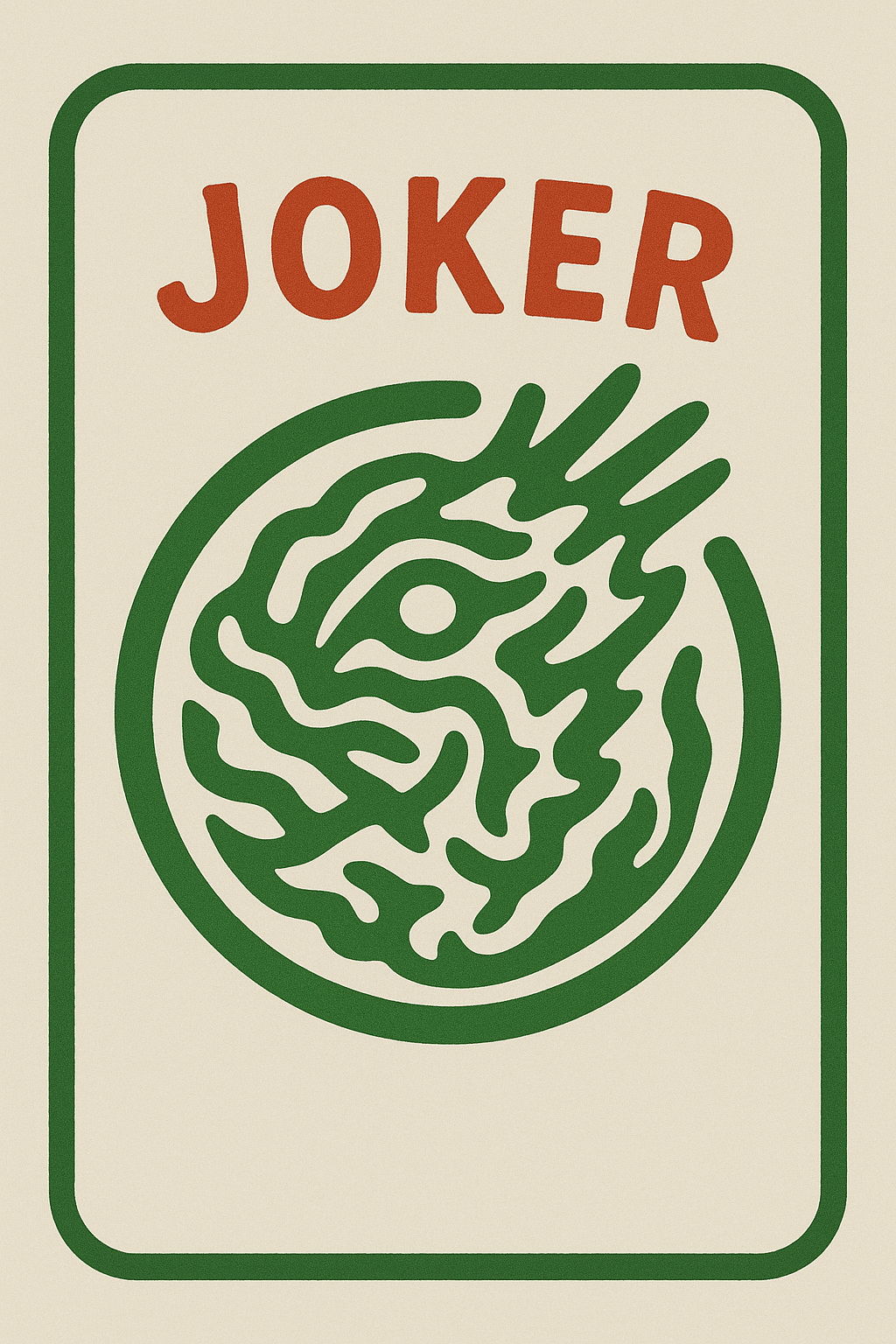
🃏What Is an American Mahjong Joker Tile?
An American Mahjong joker tile is a wild tile used only in American Mahjong (not Chinese or other versions). It can substitute for almost any tile needed to complete a hand — making it one of the most powerful tiles in the game.
Key Facts:
- Jokers are wild - They can stand in for most tiles
- Used only in American Mahjong
- A standard American set has 8 Joker tiles
- They usually say "JOKER" in red letters
- Cannot be used as single tiles - Only inside pungs (3 of a kind), kongs (4 of a kind), or quints (5 of a kind)
What Jokers CANNOT Do:
- ❌ Cannot be used as singles or pairs
- ❌ Some hand patterns in certain private or unofficial rule references may restrict joker use
- ❌ Cannot represent Flowers or Seasons
- ❌ Can be exchanged: If someone has the real tile, they can swap it for your joker
🔄 The Joker Exchange Rule
What It Is:
The Joker Exchange lets you swap a natural tile from your hand (or rack) for an opponent's exposed Joker. This adds strategic depth by letting you grab needed tiles for your sets while giving your opponent a wildcard they can use elsewhere.
When It Happens:
On your turn, after you've drawn or claimed a tile, you can politely ask for a Joker exchange.
How It Works:
- You notice an opponent has an exposed Joker in their rack (for example, it's representing a 5 of Bamboo in their pung)
- You have the actual matching tile in your hand (the real 5 of Bamboo)
- You politely ask: "May I exchange for your Joker?"
- You give them the natural tile (5 of Bamboo) and take their Joker
- Their set still works perfectly, and now you have a Joker to use!
Key Rules:
- ✅ Only exposed Jokers - You cannot exchange for a Joker in someone's concealed hand
- ✅ Multiple exchanges allowed - You can exchange multiple Jokers in one turn if you have the matching tiles
- ✅ Must match exactly - The tile you give must match what the Joker is substituting for in their set
💡 Strategic Tip:
Watch what other players expose! If they have a Joker you can exchange for, and the real tile helps complete one of your sets, it's a win-win situation.
Example:
If you need 7-7-7 of Dots, you could use: 7 of Dots + 7 of Dots + Joker ✅
That joker officially becomes a 7 of Dots while it's locked into that hand.
⬜About Blanks (Unofficial House Rule)
Blanks are not part of official American Mahjong rules, but many players and social groups use them as a fun house rule.
Since blanks are unofficial and not defined by any official ruleset, groups create their own rules. Below is the standard, widely accepted way blanks are played.
Common House Rules for Blanks:
- Blanks are wild tiles - They can replace any single tile (numbers, suits, winds, dragons)
- Concealed-only - Blanks cannot be exposed or called. They must stay hidden in your hand
- Cannot be exchanged - Unlike jokers, blanks stay blanks. You cannot swap them
- Usually cannot represent Flowers - Most groups don't allow blanks to be flowers
- Maximum 1 blank per hand - Some groups allow two, but rarely more
- Can be used to win Mahjong - If the pattern is satisfied, you can win with a blank
Note: Since blanks are a house rule variation, always check with your playing group for their specific rules before using them.
🀄How to Deal: The Charleston & Setup Methods
The Charleston
What Is the Charleston?
The Charleston is the mandatory tile-passing phase at the start of the game, before the first discard. It helps players improve their hands by exchanging unwanted tiles for new ones.
Purpose:
- Improve your starting hand
- Get rid of unwanted tiles
- Build toward one of the valid hand patterns shown on your chosen unofficial or privately owned reference card
- No one can claim a win or call tiles during the Charleston
🔁 The Standard Charleston Pattern
Each player passes exactly 3 tiles at a time in this order:
- Right → Pass 3 tiles to the player on your right
- Across → Pass 3 tiles to the player across from you
- Left → Pass 3 tiles to the player on your left
After each pass: Push out 3 tiles face down, receive 3 new tiles, add them to your rack before the next pass.
🔄 The ROL / LOR Choice
After the first three passes (Right, Across, Left), the table has a choice:
✅ ROL (Right-Across-Left AGAIN)
Repeat the same pattern:
- Pass Right
- Pass Across
- Pass Left
Total: 6 passes
✅ LOR (Left-Across-Right)
Reverse the direction:
- Pass Left
- Pass Across
- Pass Right
Total: 6 passes
🗳️ How Is ROL or LOR Chosen?
All players usually agree as a table. Some groups let the dealer decide or take a quick vote. There is no single governing authority that universally requires one choice over the other — both options are commonly used in social and competitive play.
🤝 The Courtesy Pass (Optional)
After the Charleston is complete, there's one final optional tile exchange called the Courtesy Pass (or Optional Pass).
What Is the Courtesy Pass?
A final, optional tile exchange with the player directly across the table. It's your last chance to get rid of unwanted tiles before gameplay begins.
Key Aspects:
- ⏱️ Timing: Occurs once, after the main Charleston is complete
- 👥 Participants: Exchange tiles only with the player opposite you
- 🔢 Number of Tiles: Each player states 0-3 tiles; the lower number is exchanged
- 🚫 Optional: Not required - you can pass zero tiles if you prefer
- 🎯 Strategy: Discard tiles that don't fit your hand or get rid of joker bait
How It Works in Practice:
- End of Charleston: Once all Charleston passes conclude
- Agreement: Players opposite each other say, "I'll pass [0, 1, 2, or 3]"
- Exchange: If Player A says "3" and Player B says "1," they exchange only 1 tile
- Proceed to Play: After the Courtesy Pass (or if skipped), the game begins
💡Example
You want to pass 3 tiles, but your opponent only wants to pass 1 tile. You both exchange 1 tile (the lower number). You keep your other 2 unwanted tiles.
✅ What Happens After the Courtesy Pass?
Once the Courtesy Pass is complete (or skipped), the real game begins with drawing, discarding, and calling for pungs, kongs, and mahjong.
Messy Mahjong (House Rule)
Messy Mahjong (also called "Down & Dirty" or "Freestyle") is a popular house rule that speeds up setup by skipping wall building entirely.
How It Works:
- Mix Tiles: Dump all tiles face-down in the center and shuffle them thoroughly
- Deal Hands: East (Dealer) draws 14 tiles; other players draw 13 tiles randomly from the pile
- Charleston: Play the standard Charleston as normal
- Gameplay: East discards first. Players draw randomly from the face-down pile and play continues normally
Key Differences from Standard Play:
- ❌ No Walls: Tiles are dumped in the middle, no wall building required
- ⚡ Fast Dealing: Eliminates time spent building and breaking walls
- 🎲 Random Draws: Players draw from anywhere in the central pile
Why Play Messy Mahjong?
- Speed: Significantly cuts down setup time
- Casual: Great for beginners or quick games
- Practice: Play more hands in less time
Note: As a house rule, specifics can vary. Always confirm the exact logistics with your playing group before starting.
🧱How to Build Your Wall in American-Style Mahjong
Building the wall is the first step before dealing tiles
Building the wall is the first step before dealing in a traditional American-style Mahjong game. The wall holds all the tiles that players will draw from during play.
Some social groups also include blank tiles as a house rule, which slightly changes the total number of tiles in the wall.
✅ What You Need Before Building
- A full Mahjong tile set
- Four players
- A flat playing surface
- (Optional) Blank tiles, if your group uses them
🧱 Step-by-Step: How to Build the Wall
1. Turn All Tiles Face Down
Place all tiles face down on the table so no one can see their values.
2. Mix the Tiles Thoroughly
Using both hands, all players shuffle and mix the tiles together in the center of the table to ensure a fair, random distribution.
3. Each Player Builds a Wall
After mixing:
- Each player pulls tiles toward their side
- Each wall is built:
- 2 tiles high
- 17 tiles long
This means each player uses: 34 tiles per wall
4. Push the Four Walls Together
The four walls are slid together to form a square in the center of the table. This creates the full Mahjong wall from which all drawing will occur.
🔢 How Many Tiles Are in the Wall?
✅ Standard American-Style Set (No Blanks)
Most modern American-style Mahjong sets contain:
- Suited tiles (Bams, Cracks, Dots)
- Winds
- Dragons
- Flowers
- Jokers
This totals 152 tiles, which fits perfectly into:
4 walls × 34 tiles each = 136 wall tiles + remaining draw tiles used during play
(Some tiles are drawn immediately during dealing.)
✅ If You Add Blanks (House Rule)
Blank tiles are not part of the standard tile count, but many groups add:
- 2 blanks
- 4 blanks
- Occasionally 6 blanks
Here's how that changes the total:
- With 2 blanks → 154 tiles total
- With 4 blanks → 156 tiles total
- With 6 blanks → 158 tiles total
The wall is still built the same physical way — the only difference is that extra tiles remain in the draw pile.
🎲 Choosing Where to Break the Wall
Many groups roll dice to decide:
- Which wall to start from
- Where the opening break occurs
The exact method varies by group, but the goal is always to randomize the starting point.
⚡ Alternative Setup: Messy Mahjong (House Rule)
Some groups skip wall building entirely:
- All tiles are mixed face down in the center
- Players draw randomly from the pile
- Play begins immediately
This method is:
- Faster
- More casual
- Popular for practice games
✅ One-Line Summary
In American-style Mahjong, all tiles are shuffled face down and built into four walls of 17 stacks each. If blanks are added as a house rule, the total tile count increases, but the wall is built the same way.
Frequently Asked Questions
Quick answers to common American Mahjong questions
✅ 1. What is the difference between American Mahjong and Chinese Mahjong?
Short answer: American Mahjong uses jokers, racks, reference cards with changing hand patterns, and Charleston passing. Chinese Mahjong does not use jokers or reference cards and has different scoring and rules.
✅ 2. How many jokers are in an American Mahjong set?
A standard American Mahjong set contains 8 Joker tiles. Jokers are wild and can be used in most sets, except where specifically prohibited by certain hand patterns.
✅ 3. What is the Charleston in American Mahjong?
The Charleston is the opening tile-passing phase where players exchange 3 tiles at a time to improve their hands before regular play begins.
✅ 4. What does ROL or LOR mean in Mahjong?
ROL = Right, Across, Left
LOR = Left, Across, Right
These refer to the optional second round of Charleston passes after the first three passes are completed.
✅ 5. Can you use a joker in a pair?
❌ No. Jokers may not be used in:
- Singles
- Pairs
✅ They can only be used in:
- Pungs (3 of a kind)
- Kongs (4 of a kind)
- Quints (5 of a kind)
✅ 6. Can someone take your joker in American Mahjong?
✅ Yes. If a joker is exposed in a set and another player holds the real matching tile, they may exchange it for your joker at any time.
✅ 7. How do you decide which hand pattern to play?
Players typically:
- Pick 2–4 possible hand patterns
- Collect tiles that fit those patterns
- Stay flexible until one path becomes clearly achievable
Most players do not lock into a single pattern at the start of the game.
✅ 8. What happens if two players call the same tile?
If two players want the same discarded tile:
- The player who can declare Mahjong gets priority
- If neither can declare Mahjong, the closest player in turn order gets it
✅ 9. Can you change your mind after exposing tiles?
✅ You may change your intended hand as long as:
The exposed tiles still legally fit some hand on the card
❌ If the exposed tiles fit no valid hand, the hand is dead.
✅ 10. Is American Mahjong hard to learn?
No — most beginners learn the basics in 2–3 games. Reference cards may look overwhelming at first, but once players understand:
- How sets work
- How the Charleston works
- How jokers work
The game becomes very intuitive and social.
📜 Disclaimer
This website is an independent, educational resource created to help players better understand common concepts, terminology, and patterns used in American-style Mahjong. This site does not display, replicate, summarize, or adapt any proprietary scoring card content. All examples shown are original, generalized demonstrations created solely for educational discussion.
All examples, explanations, and hand structures shown on this site are general interpretations of how American Mahjong hands are typically formatted and played across various rule sets. They are not copies of any specific proprietary reference card, nor do they represent content from any commercial scoring system.
This site is not affiliated with, endorsed by, or sponsored by any governing Mahjong organization. For authoritative rules and scoring information, please consult your privately owned reference card or the organization that publishes it.
This tool is offered for educational and recreational purposes only. Users should always consult their chosen reference materials for gameplay decisions.